
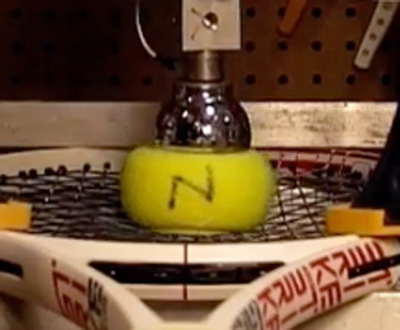
Impact mechanics
Racquet–ball impact, power and shot speed
Follow energy and momentum through the collision, distinguish power from shot speed, and see why impact location matters.
Open Racquet Performance AnalysisTennis Warehouse University
Original experiments, measured performance, and practical tools for understanding tennis equipment and play.
Every tennis shot is a rapidly unfolding physics experiment. The racquet accelerates and collides with the ball; the ball and strings deform; the racquet bends, twists and recoils; and the ball leaves with a new speed, direction and spin. Tennis Warehouse University studies these events through controlled experiments, direct measurement and physical analysis—and turns the results into tools players can use.
What makes TWU different
TWU does not stop with a general explanation. A specific question is converted into a repeatable test, the result is measured and analyzed, and useful findings are incorporated into equipment-comparison tools.
Question → Hypothesis → Experiment → Measurement → Analysis → Conclusion → Player Tool
The subject
Tennis physics is the study of the forces, motions, collisions and material behavior involved in playing tennis. It includes mechanics, energy transfer, momentum, rotation, friction, elasticity, vibration and aerodynamics.
Some questions can be approached with established physical laws. Others require experiments because real racquets, strings, balls, courts and strokes are more complicated than idealized objects in an equation. TWU combines both approaches.
Explore the science
Start with the subject that interests you, then move from the overview to the original experiments, analysis and tools.
Impact mechanics
Follow energy and momentum through the collision, distinguish power from shot speed, and see why impact location matters.
Open Racquet Performance Analysis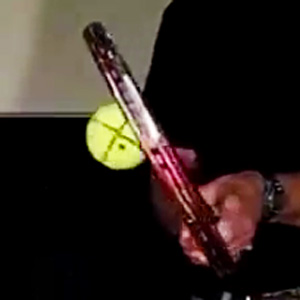
Friction and rotation
Examine relative contact velocity, sliding, gripping, friction, string movement and snap-back during oblique impacts.
Compare string spin potential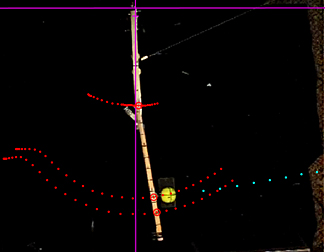
Mass and rotation
Learn why total weight is not enough, how mass location changes rotational behavior, and what added mass does to a swing.
Open the Customization Tool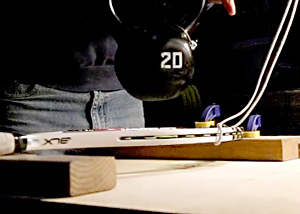
Materials and deformation
Compare measurable string properties and see how stiffness, tension loss, friction and deformation shape performance.
Open the String Performance Database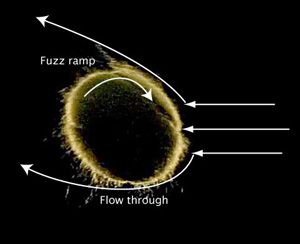
Aerodynamics and bounce
See how speed, launch angle and spin combine with gravity, drag and lift to produce a tennis-ball trajectory.
Open the Shot Trajectory Tool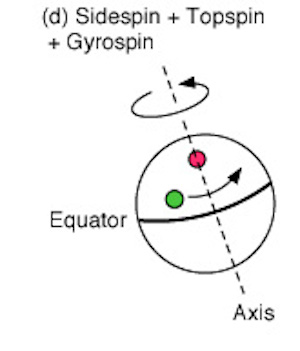
Linked motion
Use simplified linked-segment models and experiments to investigate timing, rotational energy and racquet-head speed.
Compare strokes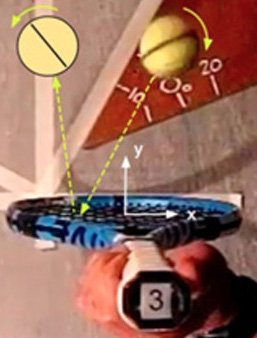
What the player feels and controls
Separate terms that are often blended together. Racquet recoil, twist, frame bending, stringbed stiffness, impact shock and post-impact vibration are related, but they are not the same event or measurement.
Use the science
TWU tools connect laboratory measurements to the questions players actually ask when comparing racquets and strings.
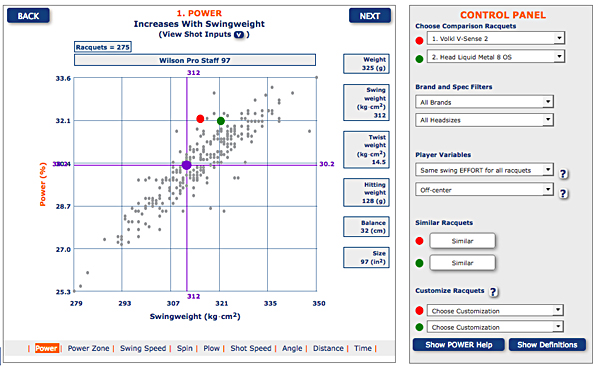
Compare racquets by power, power-zone size, swing speed, spin, plow-through, shot speed, launch angle and trajectory.
Analyze racquets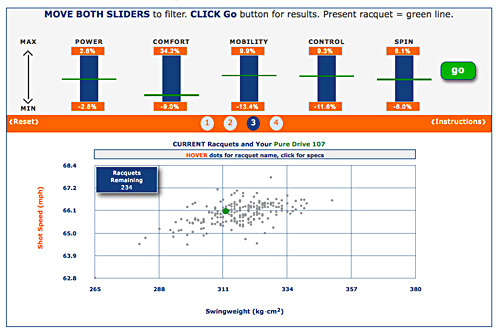
Use measured racquet specifications and performance characteristics to identify suitable alternatives.
Find racquets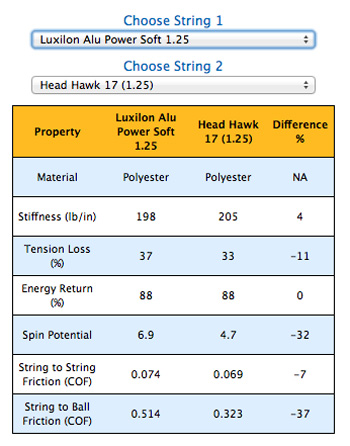
Compare stiffness, tension loss, energy return, impact force, friction, spin potential and related properties.
Compare strings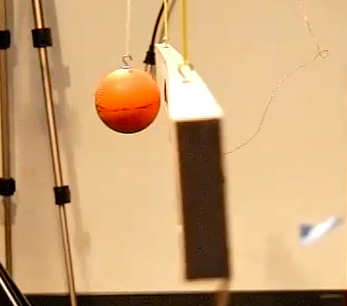
Calculate where and how much mass to add to reach target weight, balance and swingweight values.
Customize a racquetA place to begin
These studies show how TWU moves from a focused question through apparatus, measurement, analysis and conclusion.
Follow kinetic and elastic energy as the ball and strings deform and recover during impact.
Test how string material, movement and friction affect the outgoing spin of the ball.
Measure free flight to examine aerodynamic drag and lift on spinning and non-spinning balls.
Investigate rebound speed, rebound angle, spin, friction and contact velocity.
Measure how added mass changes racquet motion and ball speed instead of relying on assumption.
Track changes in tension, stiffness, force, deflection and other performance properties.
Different questions, one laboratory
Understand what equipment measurements mean and use them to narrow racquet and string choices.
Connect racquet motion, impact conditions, spin and trajectory with observable ball behavior.
Explore real applications of mechanics, energy, momentum, friction, elasticity and aerodynamics.
Review apparatus, methods, measurements, analysis and references involving actual tennis equipment.
Use measured string and racquet properties to support customization and equipment comparison.

About the research
TWU is dedicated to helping players scientifically compare and choose equipment while increasing access to tennis-science education. It develops purpose-built testing methods, measures actual equipment performance, conducts controlled experiments and creates interactive tools from the resulting data.
TWU is developed by Crawford Lindsey, coauthor of The Physics and Technology of Tennis with Howard Brody and Rod Cross, and Technical Tennis with Rod Cross. Many TWU experiments have been conducted in collaboration with Rod Cross of the University of Sydney.
Read about TWU and its researchFundamental questions
Racquet power depends primarily on effective mass and energy losses at the impact location. Mass distribution, swingweight, twistweight, frame behavior, strings and impact location all contribute. Racquet power is not the same as shot speed; shot speed also depends on racquet speed.
Spin is influenced by racquet path, racquet-face angle, relative contact velocity, string-to-ball friction, string-to-string friction and string movement. Strings that slide and snap back while maintaining traction on the ball can contribute to outgoing spin.
Topspin changes the airflow around the ball and produces a downward aerodynamic force. Together with gravity and drag, this makes a topspin shot curve toward the court more rapidly than a non-spinning shot launched under otherwise similar conditions.
Swingweight measures a racquet's resistance to rotational acceleration around an axis near the handle. It depends on both the amount of mass and its distance from the axis of rotation.
Twistweight measures a racquet's resistance to rotation around its long axis. It is especially important during impacts away from the racquet's center line.
“Sweet spot” can refer to minimum vibration, minimum impact shock, maximum power or a preferred hitting zone. Those locations do not necessarily coincide, so the intended meaning should be defined whenever the term is used.
Begin exploring
That is why experiments matter. Examine the measurements, methods and conclusions—and use the tools to discover how racquets, strings, balls, strokes and courts work together.